A Heap of Good "Bugs" in Your Compost Pile Keeps Nutrients Flowing
Updated: 7 hours ago
By Eric R. Eaton
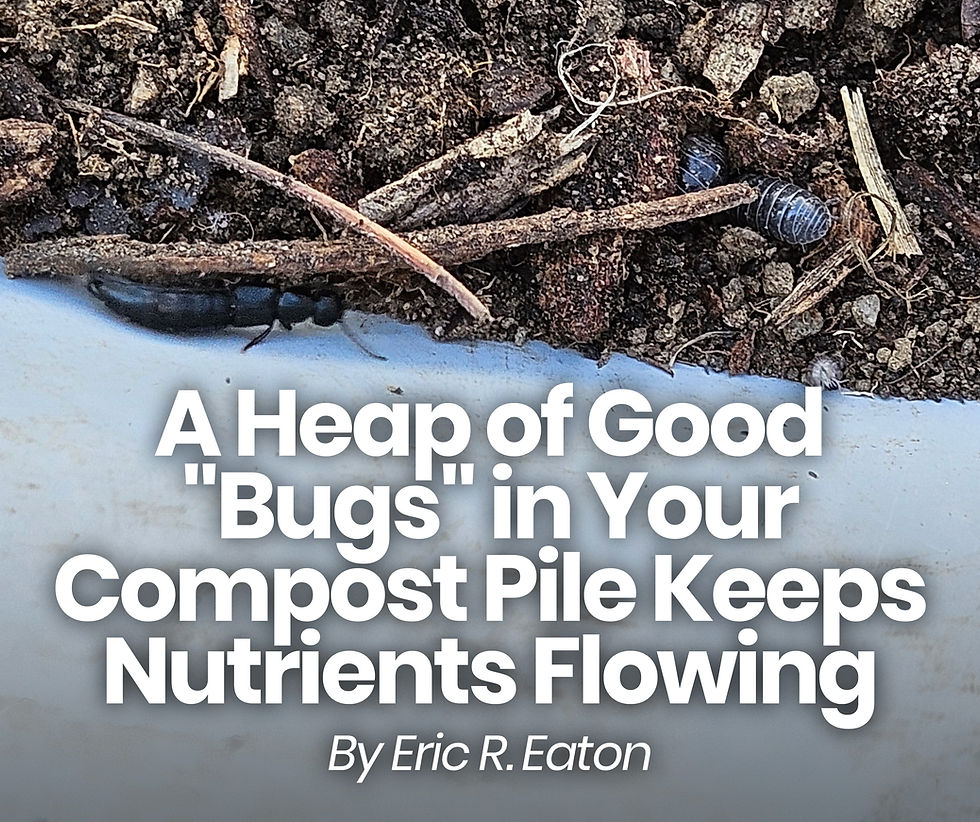
Earthworms are acclaimed composters, but having insect activity in your compost is a good thing, too. It means you have a healthy mini-ecosystem that includes decomposers that break down decaying organic matter into nutrient-rich natural fertilizer. Thus, the vegetable scraps from this year's harvest feed next season's crops. Let's explore this realm with a magnifier and microscope. Prepare to be amazed.
Philonthus Politus Staphylinidae Drosophila Psychodid Armadillidium Vulgare
"Mite-y" Abundant
Your compost is teeming with mites, perhaps the most numerous and diverse arthropods in all soil ecosystems. They are arachnids related to spiders, scorpions and harvestmen. Mites in soil and compost have a collective appetite for decaying plant matter, bacteria, yeast, algae, and fungi. Others are predatory or parasitic on small invertebrates. Oribatid mites, also known as moss or beetle mites, have dark, shiny, helmet-like exoskeletons. Mesostigmatid and prostigmatid mites are pale, softer-bodied, and appear similar to each other, except for the placement of their breathing holes: along the sides of the body in the order Mesostigmata, and at the base of the mouthparts in suborder Prostigmata.
A Spring in Their Rear?
Springtails are primitive enough that many scientists consider them "non-insect hexapods" in the class Collembola. They are small, under one quarter of an inch, and named for organs that can catapult them away from the jaws of a would-be predator. A forward-directed appendage called the furcula fits into a latch-like organ called the tenaculum on the underside of the springtail, near its posterior. When the tenaculum is released, the furcula strikes the ground and propels the springtail up and away. Not every kind of springtail possesses this nifty device, so there are springtails that don't....spring. Springtails may exceed mites in their abundance in soil and leaf litter. They survive about a year consuming fallen leaves, fungi, and algae. You may even find springtails indoors, on the water in the dog dish, in the shower, tub, basin, or soil of houseplants.
Scarabs and Other Beetles
Many kinds of beetles inhabit your compost, existing in several life stages as scavengers or predators. Manure and/or decaying wood in your compost may attract scarabs. The female beetle lays her eggs in the organic mix, and the c-shaped grubs that hatch will feed and grow.
Ultra-tiny featherwing beetles are among the smallest of insects. They feed on mold spores and fungal hyphae as adults and larvae. They are so small that the female can only accommodate one egg in her abdomen at a time.
You may glimpse fast-moving beetles like ground beetles (family Carabidae), and serpentine "rove beetles" (family Staphylinidae), as they hunt insect larvae and other small creatures. Both the adults and their larvae enjoy the predatory lifestyle. Round hister beetles prey on the eggs and tiny maggots of flies. Mites will hitch rides on histers to transport themselves (phoresy).
Flies in the Organic "Soup"
Adult flies flit around the compost bin, or alight on the edges, but in the layers of waste their maggots are doing the work of decomposition. Banana peels and other fermenting food scraps attract tiny "fruit flies" in the family Drosophilidae. Entomologists call them "pomace flies" or "vinegar flies" for their association with fermentation. Indeed, the larvae of these miniscule creatures feast on yeasts and other fungi that attack decaying sugars and continue the process that renders solid fruits a soupy, alcoholic mess.
Scuttle flies look much like pomace flies, but run around erratically. Our common species, Megaselia scalaris, is an abundant scavenger of any decaying organic material. These flies won't wait for you to take out the garbage, and larvae may even develop in the residue in the disposal of your kitchen sink.
You know those tiny fuzz balls on the wall of your basin, tub, or shower? Those would be moth flies in the family Psychodidae. Moth fly larvae enjoy eating algae, bacteria, and fungi, especially if it is exceedingly wet or sludge-like. Yum.
Woodlice are "Good-lice"
You know them as sowbugs, pillbugs, and roly polies, but scientists call them woodlice, terrestrial crustaceans classified as isopods. These non-insects are often the most noticeable of compost residents, especially if you look with a flashlight at night. They require a cool, moist environment because they breathe through gills called pleopods. Their closest relatives are fully aquatic crustaceans. Still, they would drown if submerged, so heavy rains may drive them to seek refuge in your basement, garage, or home. Woodlice subsist mostly by scavenging decaying wood and rotting plants. Our common species of isopods are European, probably introduced here centuries ago in soil used as ship's ballast.
The benefits of composting to your yard and garden should be obvious, but look at what you are feeding in the meantime: an entire biosphere in miniature, pretty much. Just remember that if you're hungry, they're hungry. Bring them inside. Wait, that's not how it goes.…
Eric R. Eaton is principal author of the Kaufman Field Guide to Insects of North America and many other books including, Insectpedia, Wasps: The Astonishing Diversity of a Misunderstood Insect, and Bugwatching: The Art, Joy, and Importance of Observing Insects. He writes the blog “Bug Eric” (bugeric.blogspot.com)