Saving Seeds
Updated: Aug 31
By Jane Shellenberger:

Humans have been savings seeds for thousands of years. Just a century ago our food came from roughly 1,500 plants, plus thousands of different cultivated varieties. The United States is a country of immigrants. Many brought seeds with them from their homelands and passed these heirlooms on through the generations. Pots of planted vegetables even filled the fire escapes of city tenements.
People saved their own seeds because there was no other choice, and they selected the best plants from the varieties they liked because they tasted good, yielded early, kept their kids healthy, resisted pests, thrived with less water, tolerated early frosts, or any number of other reasons.

But the tradition and art of seed saving almost disappeared in the latter half of the 20th century. As more people moved to urban areas and suburbs, home food gardening became less popular than lawn care. People were buying their food in supermarkets, with produce trucked or flown in. Fast food and junk food replaced vegetables in our national diet. The continuing disappearance of small family-owned farms overshadowed a back-to-the-land movement in the early 1970’s. Today, just four plants, wheat, rice, corn, and soybeans, provide more than 75% of the calories humans consume, and that diverse pool of 1,500 food plants has shrunk to about 30.
As more profitable hybrids came to dominate the seed industry, many of the smaller seed companies that had carried collections of unique home garden, open-pollinated vegetable varieties went belly-up. Big seed companies swallowed up little ones.
In 1975, Seed Savers Exchange was founded in an effort to locate and preserve heirloom seeds. Today, some 50+ years later, a renaissance in food gardening is underway, based largely on a desire for more sustainable, healthy living, but also on survivalist fears of possible future food shortages. Whatever the reason, seed saving is finally beginning to catch on again.
Saving seeds is both simple and complex. The act of harvesting and saving seeds is simple. And the reproductive systems and genetics of some plants make it easy to know for sure that the seeds you collect will produce the plants you want. But wherever diversity exists there is complexity in plant sexual reproduction and more possibility for genetic variation. It isn’t always straightforward.
The seeds worth saving come from open-pollinated varieties, not hybrids. Seed from hybrid varieties does not produce plants that “come true” and have the same traits and characteristics as the parent plant, and in most cases hybrid offspring will be plants that disappoint.
Vegetables like lettuce and tomatoes are annuals that produce seed in their first year. Carrots and beets are biennials that flower and produce seed in their second year. Some plants have both male and female flowers on the same plant, others have just female or just male flowers. Some are “perfect flowers” meaning they have both male stamens that produce pollen and a female pistil that receives pollen. Some plants are self-pollinating, while others won’t accept their own pollen. Insects (mostly honeybees) pollinate most flowers, but the wind manages it for all the grasses, including corn.
Because different varieties of some species will cross readily with each other, it’s necessary to isolate them in some way, either by physical distance, or by planting them to mature and flower at different times. For example, all of the brassicas (broccoli, cabbage, Brussels sprouts, kale, etc.) will cross with one another. Squash types and varieties within the same species will cross; acorn will cross with delicata, but not with hubbard or butternut.
Physically separating plants any significant distance is very difficult in a small garden, and where neighbors’ gardens are next to each in adjoining lots.
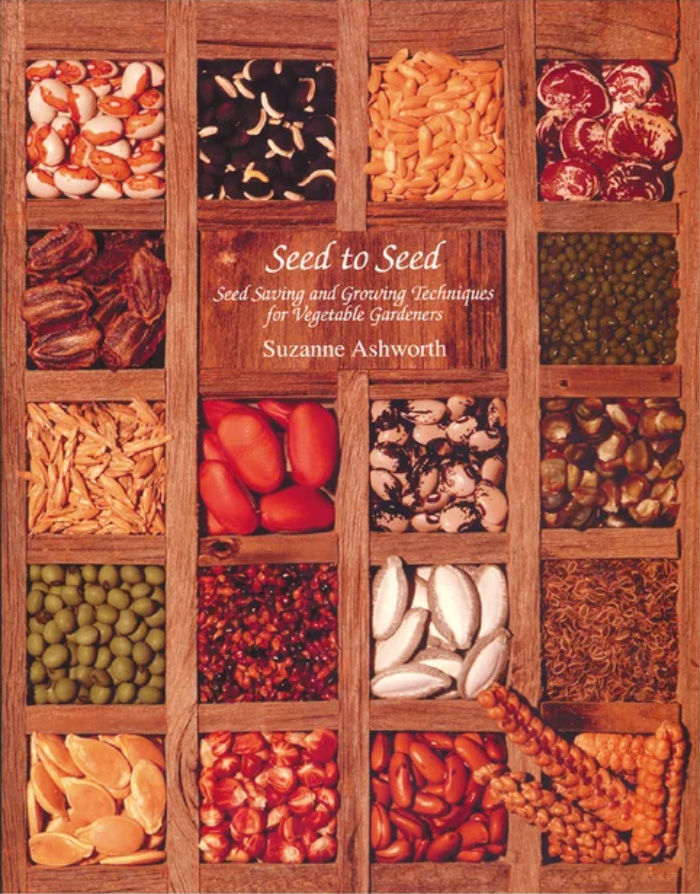
The list below includes the easiest, most straightforward vegetables for seed saving, which is a good place to start. (For more advanced and detailed seed saving techniques see Seed to Seed by Suzanne Ashworth and Basic Seed Saving by Bill McDorman.)
Once harvested and cleaned (if necessary), seeds should be kept in a cool, dark, and most important of all, dry place for storing. Put seeds in plastic bags and put the bags in air-tight glass jars. Old vitamin bottles with silica packets work well too. Label them right away so you don’t forget what you have collected.
Easiest Vegetables for Seed Saving
(ideal separations listed are for commercial growing, viability numbers assume proper storage)

Beans (Phaseolus vulgaris or common bean) Flowers of common green beans are perfect and self-pollinating, and cross-pollination by insects is rare. Ideal separation: 150 feet. Home garden reality: Don’t grow two different varieties side by side, and never grow two different white-seeded varieties next to each other because you won’t be able to tell if crossing has occurred. Viability - 4 years.

Lettuce (Latuca sativa) Perfect, self-pollinating flowers form in small heads of 10-25 flowers. All open on the same day for a short time, usually in the morning, and form one seed pod each. Ideal separation: 20-24 feet. Home garden reality: 12-20’ for different varieties.
Seeds ripen at different times over a period of 12-24 days after flowering. Harvest when half the head has gone to seed. Viability – 3 years.
Peas (Pisum sativum, garden & edible pod pea) Perfect, self-pollinating flowers, cross-pollination by insects is rare, but possible. Ideal separation: 50’ or grow another crop that flowers at the same time in between different varieties. Reality: Pea varieties rarely cross-pollinate.
Allow pods to dry brown, four weeks after eating stage. If a freeze is expected and row cover won’t suffice, pull up the whole plant by the roots and hang it upside down in a warm, dry place until pods are brown. Open pods by hand or flail (crush) larger amounts. Viability – 50% germination for 3 years.

Peppers (Capsicum annuum) Perfect, mostly self-pollinating flowers, but honeybees and solitary bees also pollinate them. Studies show up to 80% crossing. Ideal separation: 400’. Reality: 50’ with a tall flowering crop in between.
Harvest fully ripe peppers for eating and save the seed. Most peppers start out green and change color (turning yellow, orange, red, purple or black) when fully ripe. If a freeze is expected and row cover won’t suffice, pull up the whole plant by the roots and hang it upside down in a warm, dry place. Cut off the bottom of the fruit and reach in to harvest the seeds in the center. Viability – 50% germination for 3 years.
Tomatoes (Lycopersicon esculentum) Perfect, self-pollinating flowers. Most modern varieties have short (retracted) styles so cross pollination is very rare, in heirlooms and older varieties with longer styles it is more common so greater separation is needed. Use a magnifying glass to examine the flowers. Don’t save seed from varieties with double flowers since they’re more prone to insect pollination. Ideal separation: 10’ for short style varieties, 100’ for long style varieties. Reality: Extent of crossing is controversial and opinions differ. Some growers don’t see crossing even when tomatoes are grown next to each other.
Allow tomatoes to fully ripen before harvesting for seed. If that isn’t possible pick the unripe, green fruit and let it slowly ripen in a cool dry place. Let it change color before harvesting seed. Cut the tomato into halves across the middle (equator) and squeeze out the jellylike substance with the seeds into a small glass or jar with a little water. Loosely cover and put in a warm place for about three days, stirring once a day.
A layer of fungus will appear on top - this is a good thing. After three days fill the container with warm water and allow contents to settle. Carefully pour out the water, tomato pulp, and floating immature seeds. Repeat until water is almost clear. Pour clean, viable seeds at the bottom of the jar into a strainer to drain. Dump seeds out onto a paper towel to dry thoroughly for a day or two, break up the clumps and store. Viability: 4-10 years, depending on variety.

Other easy vegetables, flowers, and herbs for seed saving are:
Chives, Mizuna, Arugula, Orach, Marigolds, Cosmos, Dill, Nasturtium, Gaillardia, Bachelor Buttons, Zinnia, Basil, Penstemon, Rose Mallow, Calendula.
When you harvest your own seeds and plant them out the next year you help plants adapt to local conditions over time. By buying seeds each year that are grown in other climates and locations, we actually deprive plants of their genetic adaptability. Seed libraries are a good way to keep local plants’ genetics in our communities at the grass roots level. I know of several that have been started by home gardeners recently in different parts of Colorado. Gardeners check out seed for free, grow out a few of the plants for seed, and return twice as much as they originally took to the library.